Is Spring 2026 a Good Time to Buy in Los Angeles, or Should You Wait?
By Paul Adams |
Is Spring 2026 a Good Time to Buy in Los Angeles, or Should You Wait? Written by Paul ...
Read Article 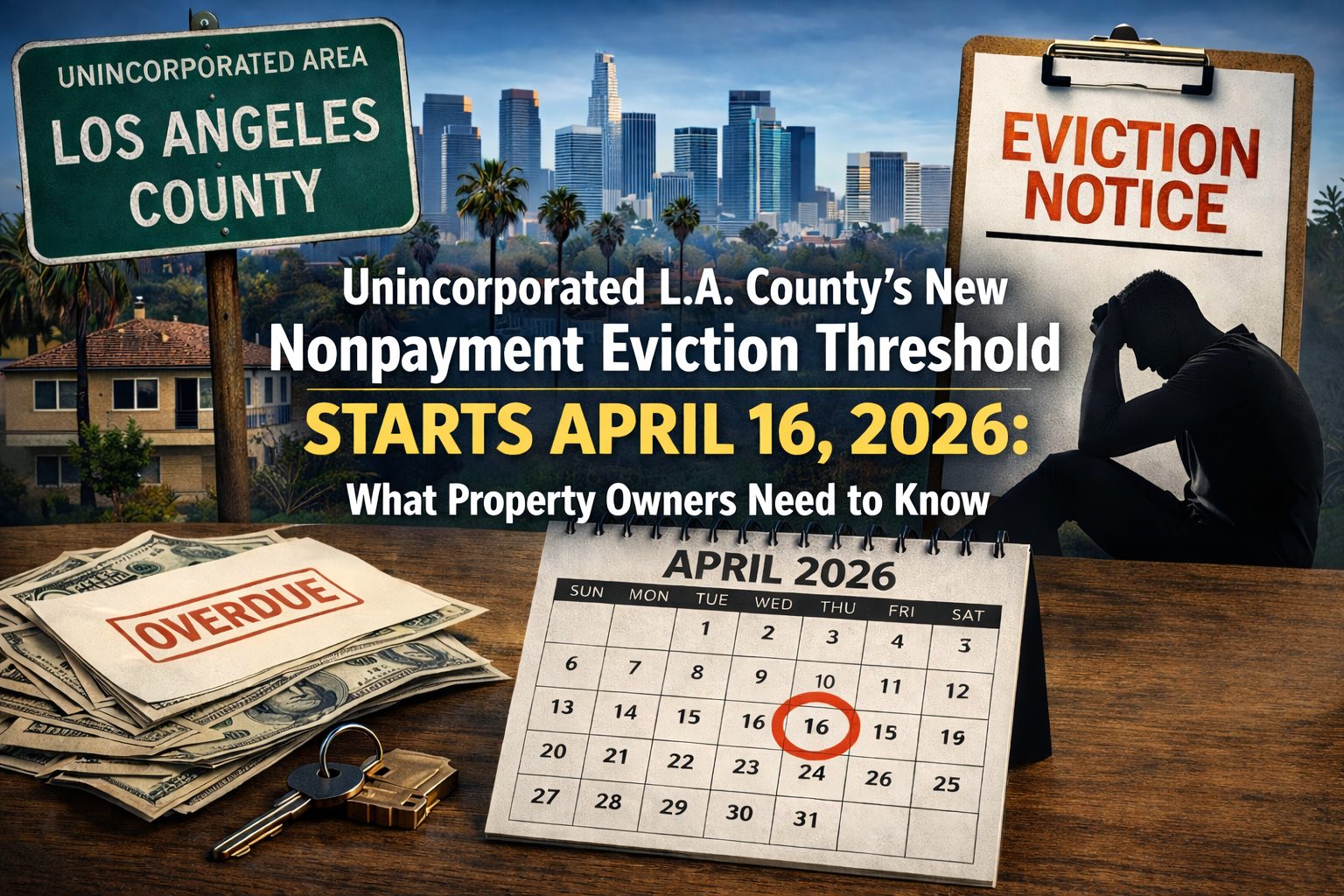
Written by Paul Adams II
Los Angeles Real Estate Advisor
Most landlords don’t lose money because of bad tenants.
They lose money because they act too late—or think they can act when they legally can’t.
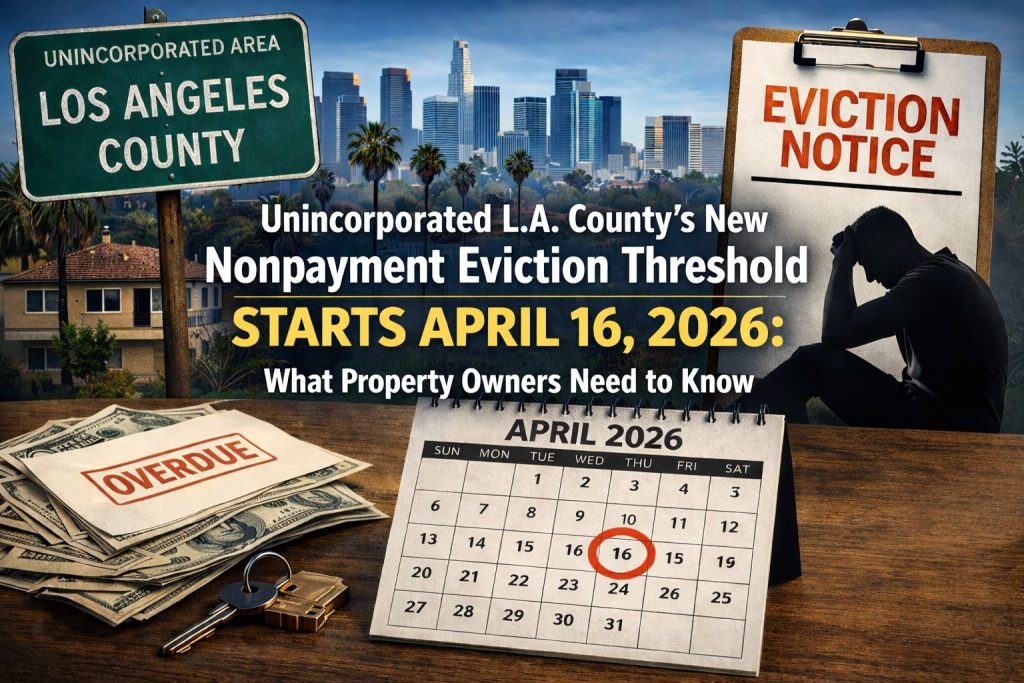
Starting April 16, 2026, in Unincorporated Los Angeles County, the rules around when you can evict for nonpayment are changing again.
And if you don’t understand how this threshold works in practice, you’re going to feel it in your cash flow.
The new rule sets a minimum amount of unpaid rent that must be reached before a landlord can legally move forward with an eviction for nonpayment.
That sounds simple.
It isn’t.
What this actually means in practice is that a tenant can be behind on rent—but still not meet the legal threshold required for eviction.
This creates a gap between:
And that gap is where most landlords get exposed.
Because during that period, you’re still covering:
With no incoming rent.
On paper, this looks like a technical rule.
In reality, it changes how risk works.
Where this becomes a real issue is in timing.
Let’s say a tenant is short on rent.
Under traditional rules, you could move quickly.
Under this system, you may be forced to wait until the unpaid balance crosses a specific threshold before initiating eviction.
That delay compounds.
Not just financially—but strategically.
Because by the time you can act:
This is where most landlords get tripped up.
They assume nonpayment = immediate action.
That’s no longer true.
Los Angeles has already shifted toward tenant protection-heavy policy over the last several years.
This threshold adds another layer.
And it disproportionately impacts:
What this actually means in practice is that your margin for error is smaller.
You’re now managing:
All at the same time.
And if you miscalculate—even slightly—you’re either:
Neither is a good outcome.
The biggest mistake I see is landlords thinking in calendar time instead of threshold-based time.
Before:
Now:
That middle step changes everything.
Because it’s not just about when rent is due.
It’s about when the unpaid amount becomes legally actionable.
And that can stretch your exposure significantly.
Especially if:
Which they often do—intentionally or not.
This isn’t just a legal change.
It’s an operational one.
Your margin for error is smaller now.
That means:
Because once a tenant falls behind, your ability to act is delayed.
It’s no longer enough to track whether rent was paid.
You need to track:
This is where most landlords lose control of the situation.
Because they’re reacting instead of monitoring.
This is non-negotiable now.
Where this becomes a real issue is when landlords rely on consistent rent to cover fixed expenses.
With delayed eviction eligibility, you may need to float:
If you don’t have reserves, you’re forced into bad decisions.
Not all of Los Angeles operates the same way.
This rule applies specifically to unincorporated areas.
What this actually means in practice is that your strategy needs to be location-specific.
Two properties a few miles apart can operate under completely different rules.
And I see landlords miss this all the time.
If you’re acquiring property this year, this rule needs to be part of your underwriting.
Not an afterthought.
Because it directly affects:
This is where most people get tripped up.
They analyze deals based on:
But ignore operational friction.
And in Los Angeles, that friction is everything.
If you’re trying to understand how these rules affect a specific deal or property you’re looking at, I can walk you through it.
Landlords used to operate with more control.
Now, it’s about management.
You’re managing:
All within a system designed to slow down enforcement.
That doesn’t mean you shouldn’t invest here.
It just means you need to be more precise.
If you’re evaluating a rental property and want to stress-test the numbers under these newer regulations, I can help you break it down realistically.
The April 16, 2026 threshold isn’t just a rule.
It’s a timing constraint.
And timing is where most landlord deals either work—or fall apart.
If you understand how to operate within it, you can still perform well in Los Angeles.
If you don’t, you’ll feel like the system is working against you.
Because in many ways, it is.
It’s a minimum unpaid rent amount required before a landlord can legally begin eviction for nonpayment in unincorporated areas.
No, it applies specifically to unincorporated Los Angeles County—not incorporated cities like Los Angeles itself.
Not immediately. The unpaid balance must meet the required threshold before eviction can proceed.
It increases risk by delaying enforcement, which can lead to longer periods without full rent collection.
Not necessarily—but deals need to be underwritten with these delays and risks in mind.



Written by Paul Adams II
Los Angeles Real Estate Advisor
Most buyers aren’t stuck because of price.
They’re stuck because they’re waiting for clarity.
And the market doesn’t give that.
If you’re thinking about buying in Los Angeles this spring, the reality is more nuanced than headlines make it sound.
Well-priced homes are still moving quickly.
Overpriced listings are sitting and getting reduced.
Buyers who act decisively are getting deals.
Buyers who hesitate are missing them.
This isn’t a hot market.
It’s not a cold one either.
It’s a selective market.
What this actually means in practice is that pricing strategy matters more than timing the market. You’re not competing against everyone—you’re competing on specific properties that are correctly positioned.
And that changes how you should think about “waiting.”
“Should I wait?”
Wait for what exactly?
Lower rates?
Lower prices?
Less competition?
Those don’t usually happen at the same time.
This is where most people get tripped up.
They assume the market will line up perfectly—lower rates, lower prices, and less competition all at once. In reality, those forces move against each other.
When rates drop, more buyers enter.
When prices drop, demand increases.
When competition decreases, it’s usually because something else got worse.
So the better question isn’t whether you should wait.
It’s what conditions actually matter for your situation.
Instead of trying to predict the market, you need to evaluate three variables:
1. Your Buying Power
This is driven by interest rates and your income.
2. Competition Level
This determines how aggressive you need to be to win a deal.
3. Pricing Behavior
Are sellers negotiating, or are they holding firm?
Where this becomes a real issue is when buyers focus on only one of these.
For example:
So even though your monthly payment might improve slightly, your ability to actually win a property gets harder.
Right now in Spring 2026, Los Angeles is sitting in an interesting window:
That creates opportunity—but only if you recognize it.
Waiting feels logical.
You want certainty.
You want a better deal.
You want to avoid overpaying.
But the cost of waiting is rarely obvious upfront.
What this actually means in practice is that buyers often trade one advantage for another without realizing it.
If you wait for lower rates:
If you wait for prices to drop:
If you wait for “the perfect time”:
This is why timing the market is less effective than positioning yourself within it.
This is where the conversation gets more practical.
Not all parts of the Los Angeles market are behaving the same way.
There are three categories of opportunities I’m seeing right now:
These are properties that missed the market.
They’re not getting offers, and sellers are starting to feel pressure.
This is where negotiation happens.
These sellers are signaling flexibility.
But the window is short—once a property looks like a “deal,” attention comes back quickly.
Bad photos. Weak listing descriptions. Limited exposure.
These are often overlooked by the broader market.
This is where buyers who are paying attention can step in without heavy competition.
The buyers who are winning right now aren’t trying to predict the market.
They’re doing three things differently:
They’re prepared.
Pre-approval is done. Financials are clear. They can move quickly.
They’re selective.
They’re not chasing every listing—only the ones that create leverage.
They’re decisive.
When the right opportunity shows up, they don’t hesitate.
This is where most people lose.
Not because they couldn’t afford the home.
But because they waited too long to act.
Here’s the real answer.
It depends on what you’re optimizing for.
If your goal is:
Maximum certainty → Waiting will always feel better
But the market doesn’t reward certainty.
Better negotiation opportunities → Right now is stronger than most buyers realize
Because competition is uneven and sellers are adjusting.
Perfect timing → It doesn’t exist
And chasing it usually costs more in the long run.
What this actually means in practice is that Spring 2026 isn’t about “good” or “bad.”
It’s about whether you understand how to operate in this type of market.
Buying in the wrong conditions isn’t what hurts most buyers.
Buying without a strategy does.
Overpaying because you rushed.
Missing deals because you hesitated.
Choosing based on emotion instead of positioning.
Those are the mistakes that matter.
And they happen in every market—hot or cold.
I’m not telling clients to rush.
And I’m not telling them to wait.
I’m telling them to get clear.
Clear on:
Because once that’s defined, the decision becomes obvious.
Not easy.
But clear.
If you’re trying to figure out whether now makes sense for you, it helps to look at your situation through this framework—not just the headlines.
Spring 2026 is a market that rewards strategy more than timing.
There are deals.
There is competition.
And there is risk.
All at the same time.
The difference isn’t the market.
It’s how you move within it.
Not necessarily. Lower rates often bring more buyers into the market, increasing competition and pushing prices up. Waiting can improve affordability but make it harder to secure a property.
Prices aren’t dropping uniformly. Some overpriced homes are being reduced, while well-priced properties still sell quickly. The market is selective rather than declining.
Competition varies by property. Desirable, well-priced homes still attract multiple offers, while others sit longer and offer negotiation opportunities.
Overpriced listings, recently reduced homes, and poorly marketed properties tend to offer the most leverage for buyers.
First-time buyers should focus on readiness and strategy rather than timing. Entering when prepared often leads to better outcomes than waiting for ideal conditions.
If you want help identifying where the real opportunities are right now—and where you actually have leverage—I can walk you through what I’m seeing across specific neighborhoods and price points. Call or text me directly at (301) 906-6252.

Written by Paul Adams II
Los Angeles Real Estate Advisor
In Los Angeles, this decision usually comes down to two options: a ground-up ADU or a garage conversion. On paper, they can seem similar. Both are ways to add usable square footage, increase rent potential, and improve the economics of a property.
But that surface-level comparison is where people start to get misled. What this actually means in practice is that two units with a similar size can perform very differently depending on layout, privacy, neighborhood demand, and how the space is perceived by both tenants and future buyers.
That gap is where the real financial difference shows up.
Garage conversions are usually cheaper. That’s the main reason they’re so attractive. Reusing an existing structure can reduce framing, foundation, and site work costs, which makes the entry point feel more manageable.
At first glance, the conclusion seems obvious. Build the cheaper unit. Get it rented. Move on.
This is where most people get tripped up. They optimize for what costs less to create instead of what produces the strongest return over time.
Where this becomes a real issue is when the lower-cost unit also comes with lower rent potential, weaker tenant demand, or a finish that doesn’t hold the same value in the eyes of a future buyer.
Not all square footage rents the same. That matters more in Los Angeles than people think because tenants are often comparing not just price, but how a space feels to live in day to day.
A garage conversion may be functional, but it can still carry the limitations of its original structure. Lower ceilings, less natural light, tighter layouts, and reduced privacy can all affect what the market is willing to pay. A well-designed ADU, by contrast, often feels more like a true standalone home.
What this actually means in practice is that tenants usually value ADUs more highly, especially when there is a separate entrance, better light, and a layout that feels intentional rather than adapted.
That difference may not look dramatic at first. Over a multi-year hold, it is.
This is one of the more overlooked parts of the decision. Higher-quality units often attract stronger tenants. That doesn’t mean every ADU renter is perfect or every garage conversion renter is difficult. It means the design and feel of the space influences who responds to it and how long they tend to stay.
Where this becomes a real issue is when owners only focus on rent and ignore turnover, maintenance, and stability. A slightly stronger tenant profile can create a much smoother ownership experience over time, especially on a property where one vacancy or one bad fit can meaningfully affect cash flow.
That’s why I don’t look at rent in isolation. I look at the quality of that rent.
Every Los Angeles neighborhood has a ceiling. You can’t build your way around that. You can only position the unit intelligently within it.
This is where most people lose money quietly. They build a premium ADU in an area that won’t support premium rents, or they settle for a basic conversion in an area where a stronger unit would have commanded noticeably more. The mismatch is what hurts the return.
What this actually means in practice is that the right answer in Venice, West Adams, or parts of Mid-City may not be the right answer in a different pocket of the Valley. Same city. Very different ceiling.
The property matters. The neighborhood matters just as much.
Many owners assume that if a unit generates income, it will automatically create equal value. That’s not how buyers think. They care about the income, but they also care about how that income is produced.
ADUs usually create cleaner value because they read more clearly to buyers, lenders, and appraisers. Garage conversions can absolutely add value too, but sometimes at a discount if the space feels more improvised than intentional.
This is where most people get tripped up. They assume income equals value one for one. It doesn’t. Perception matters. Usability matters. Buyer confidence matters.
A lot of owners go into this assuming the garage conversion is the easier path because the structure is already there. Sometimes that’s true. Sometimes it isn’t.
Older Los Angeles properties can come with structural issues, utility constraints, ceiling height problems, and other conditions that make a conversion more complicated than expected. A ground-up ADU can be more expensive, but it may also offer a cleaner development path when designed correctly from the start.
What this actually means in practice is that the cheaper option is not automatically the simpler option. That assumption is where budgets and timelines start to get distorted.
Most owners ask, “Which is cheaper to build?”
That’s not the best question.
The better questions are:
What this actually means in practice is that there isn’t one universal winner. There is only the option that best aligns with the property, the location, and your investment strategy.
A garage conversion can be the smarter move when the owner has limited capital, the neighborhood rent ceiling is more modest, and the existing structure allows for a clean, efficient layout. In those cases, speed and efficiency may matter more than maximizing absolute upside.
That doesn’t make it the weaker decision. It just makes it the right decision for a different set of priorities.
An ADU tends to make more sense when the neighborhood supports stronger rents, resale positioning matters, and the lot allows for a unit that feels private and well-designed. That is where the benefits start to compound: better tenant appeal, stronger rent, and a cleaner story when the property eventually goes back on the market.
That long-term positioning is hard to measure emotionally in the beginning, but financially, it matters.
Most owners don’t choose the wrong unit because they misunderstand construction.
They choose it because they’re asking the wrong question.
The question isn’t:
Which is cheaper to build?
The real question is:
Which creates more long-term value for my specific property?
That answer will not always be the same. In some cases, the garage conversion is the smarter move. In others, the ADU clearly wins. The point is to make the decision based on return, not trendiness.
Thinking about adding an ADU or converting a garage?
The difference in strategy can mean six figures over time. Let’s look at your property and run the numbers.
In many cases, yes. Detached ADUs often create stronger rent potential, broader buyer appeal, and better resale positioning than garage conversions, especially when the finished space feels like a true standalone unit.
Garage conversions are usually cheaper because you’re reusing an existing structure. Detached ADUs generally cost more because they involve new construction, more approvals, and more site work.
They can, but not always at the same level as a detached ADU. The value depends on layout, privacy, parking impact, neighborhood demand, and how the converted space is perceived by buyers and appraisers.
Detached ADUs usually have better rent potential because tenants will often pay more for privacy, a separate entrance, and a unit that feels more like a small home than converted space.
The best choice depends on budget, lot constraints, long-term hold strategy, neighborhood rent ceilings, and whether the owner is optimizing for short-term cash flow or long-term resale value.
Want to know what actually makes sense for your property?
Call or text me directly at (301) 906-6252. I’ll help you think through the numbers, not just the construction.

Paul Adams II | CA DRE# 02232552
Coldwell Banker Residential Brokerage Company | CA DRE# 00616212
The property information herein is derived from various sources that may include, but not be limited to, county records and the Multiple Listing Service, and it may include approximations. Although the information is believed to be accurate, it is not warranted and you should not rely upon it without personal verification. Affiliated real estate agents are independent contractor sales associates, not employees. ©2026 Coldwell Banker. All Rights Reserved. Coldwell Banker and the Coldwell Banker logo are trademarks of Coldwell Banker Real Estate LLC. The Coldwell Banker® System is comprised of company owned offices which are owned by a subsidiary of Anywhere Advisors LLC and franchised offices which are independently owned and operated. The Coldwell Banker System fully supports the principles of the Fair Housing Act and the Equal Opportunity Act.