Is Spring 2026 a Good Time to Buy in Los Angeles, or Should You Wait?
By Paul Adams |
Is Spring 2026 a Good Time to Buy in Los Angeles, or Should You Wait? Written by Paul ...
Read Article 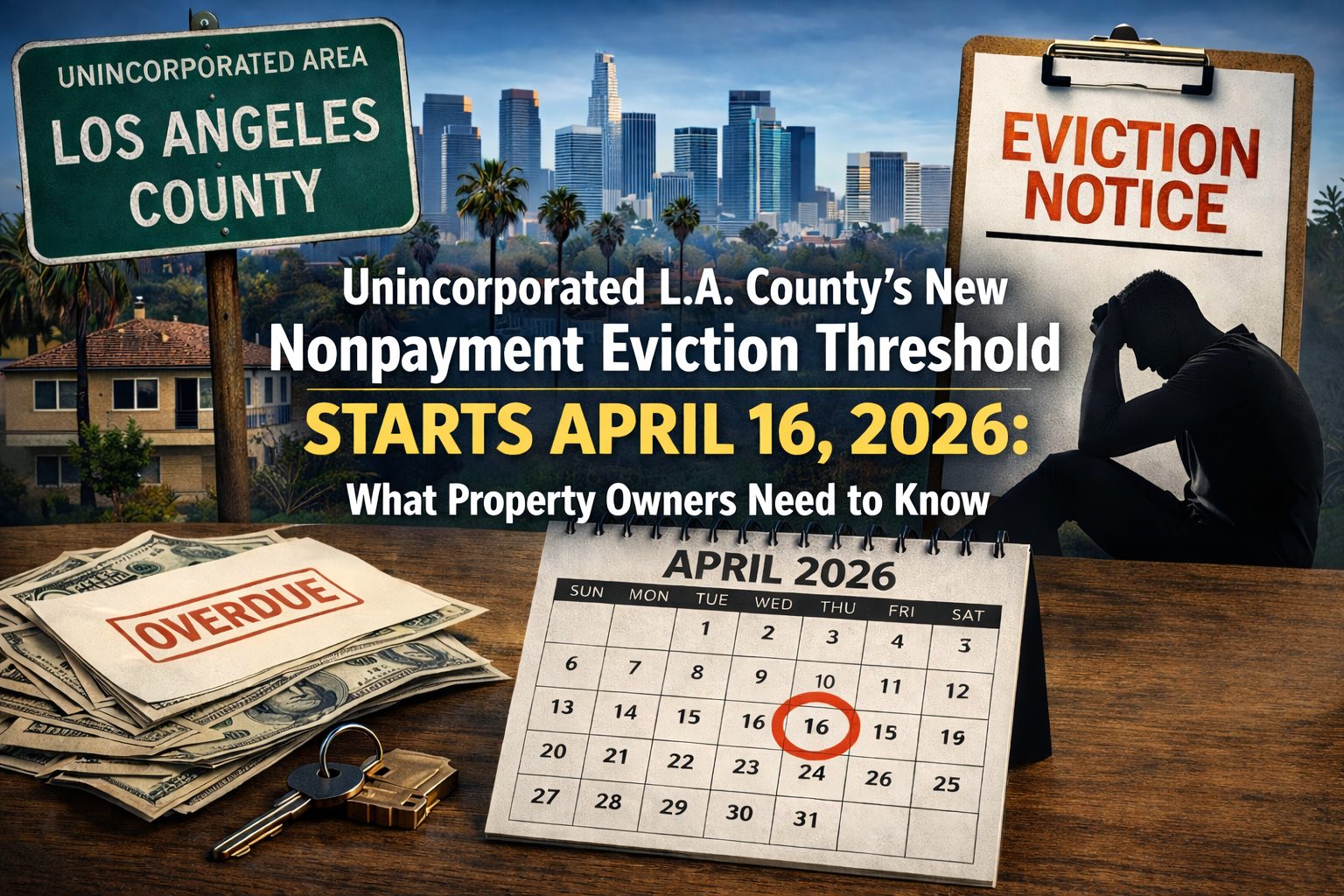
Written by Paul Adams II
Los Angeles Real Estate Advisor
Most landlords don’t lose money because of bad tenants.
They lose money because they act too late—or think they can act when they legally can’t.
Starting April 16, 2026, in Unincorporated Los Angeles County, the rules around when you can evict for nonpayment are changing again.
And if you don’t understand how this threshold works in practice, you’re going to feel it in your cash flow.
The new rule sets a minimum amount of unpaid rent that must be reached before a landlord can legally move forward with an eviction for nonpayment.
That sounds simple.
It isn’t.
What this actually means in practice is that a tenant can be behind on rent—but still not meet the legal threshold required for eviction.
This creates a gap between:
And that gap is where most landlords get exposed.
Because during that period, you’re still covering:
With no incoming rent.
On paper, this looks like a technical rule.
In reality, it changes how risk works.
Where this becomes a real issue is in timing.
Let’s say a tenant is short on rent.
Under traditional rules, you could move quickly.
Under this system, you may be forced to wait until the unpaid balance crosses a specific threshold before initiating eviction.
That delay compounds.
Not just financially—but strategically.
Because by the time you can act:
This is where most landlords get tripped up.
They assume nonpayment = immediate action.
That’s no longer true.
Los Angeles has already shifted toward tenant protection-heavy policy over the last several years.
This threshold adds another layer.
And it disproportionately impacts:
What this actually means in practice is that your margin for error is smaller.
You’re now managing:
All at the same time.
And if you miscalculate—even slightly—you’re either:
Neither is a good outcome.
The biggest mistake I see is landlords thinking in calendar time instead of threshold-based time.
Before:
Now:
That middle step changes everything.
Because it’s not just about when rent is due.
It’s about when the unpaid amount becomes legally actionable.
And that can stretch your exposure significantly.
Especially if:
Which they often do—intentionally or not.
This isn’t just a legal change.
It’s an operational one.
Your margin for error is smaller now.
That means:
Because once a tenant falls behind, your ability to act is delayed.
It’s no longer enough to track whether rent was paid.
You need to track:
This is where most landlords lose control of the situation.
Because they’re reacting instead of monitoring.
This is non-negotiable now.
Where this becomes a real issue is when landlords rely on consistent rent to cover fixed expenses.
With delayed eviction eligibility, you may need to float:
If you don’t have reserves, you’re forced into bad decisions.
Not all of Los Angeles operates the same way.
This rule applies specifically to unincorporated areas.
What this actually means in practice is that your strategy needs to be location-specific.
Two properties a few miles apart can operate under completely different rules.
And I see landlords miss this all the time.
If you’re acquiring property this year, this rule needs to be part of your underwriting.
Not an afterthought.
Because it directly affects:
This is where most people get tripped up.
They analyze deals based on:
But ignore operational friction.
And in Los Angeles, that friction is everything.
If you’re trying to understand how these rules affect a specific deal or property you’re looking at, I can walk you through it.
Landlords used to operate with more control.
Now, it’s about management.
You’re managing:
All within a system designed to slow down enforcement.
That doesn’t mean you shouldn’t invest here.
It just means you need to be more precise.
If you’re evaluating a rental property and want to stress-test the numbers under these newer regulations, I can help you break it down realistically.
The April 16, 2026 threshold isn’t just a rule.
It’s a timing constraint.
And timing is where most landlord deals either work—or fall apart.
If you understand how to operate within it, you can still perform well in Los Angeles.
If you don’t, you’ll feel like the system is working against you.
Because in many ways, it is.
It’s a minimum unpaid rent amount required before a landlord can legally begin eviction for nonpayment in unincorporated areas.
No, it applies specifically to unincorporated Los Angeles County—not incorporated cities like Los Angeles itself.
Not immediately. The unpaid balance must meet the required threshold before eviction can proceed.
It increases risk by delaying enforcement, which can lead to longer periods without full rent collection.
Not necessarily—but deals need to be underwritten with these delays and risks in mind.



Paul Adams II | CA DRE# 02232552
Coldwell Banker Residential Brokerage Company | CA DRE# 00616212
The property information herein is derived from various sources that may include, but not be limited to, county records and the Multiple Listing Service, and it may include approximations. Although the information is believed to be accurate, it is not warranted and you should not rely upon it without personal verification. Affiliated real estate agents are independent contractor sales associates, not employees. ©2026 Coldwell Banker. All Rights Reserved. Coldwell Banker and the Coldwell Banker logo are trademarks of Coldwell Banker Real Estate LLC. The Coldwell Banker® System is comprised of company owned offices which are owned by a subsidiary of Anywhere Advisors LLC and franchised offices which are independently owned and operated. The Coldwell Banker System fully supports the principles of the Fair Housing Act and the Equal Opportunity Act.