How to Buy a House in Los Angeles (Step-by-Step Guide for 2026)
By Paul Adams |
How to Buy a House in Los Angeles (Step-by-Step Guide for 2026) Written by Paul Adams II Los ...
Read Article 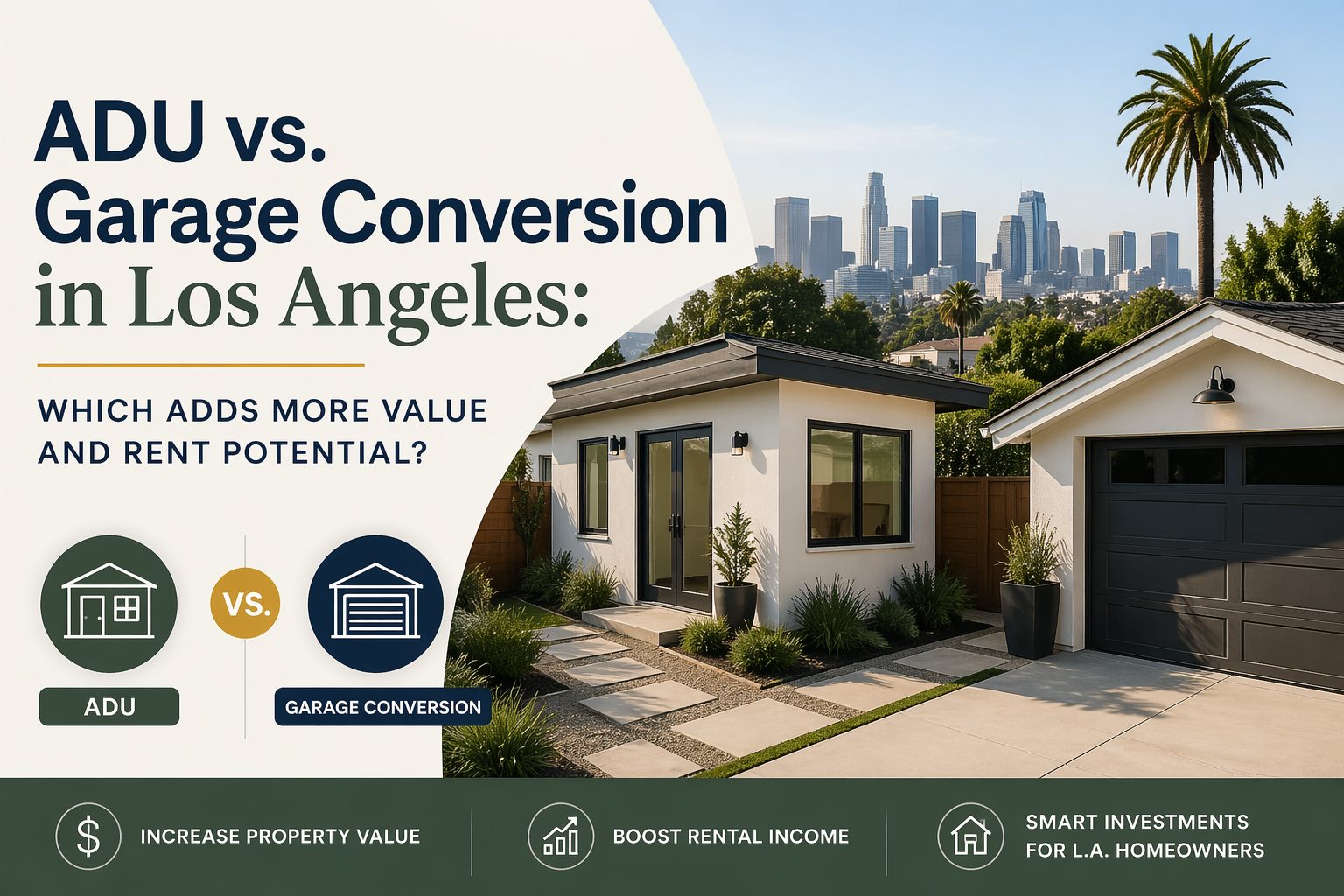
Written by Paul Adams II
Los Angeles Real Estate Advisor
Most Los Angeles property owners do not make the wrong decision because they misunderstand construction.
They make it because they optimize for the wrong variable first.
Usually, that variable is cost.
A garage conversion looks cheaper. An ADU looks more expensive. So the decision feels straightforward.
But here is what most people miss: you are not choosing between two construction options.
You are choosing between two completely different long-term financial profiles.
One may save you money upfront but cap your upside for years. The other may require more capital but create stronger income, better tenants, and a more valuable asset over time.
Once you understand that shift, the decision becomes a lot clearer.
Most owners approach this decision with a simple framework:
That logic sounds reasonable. But in practice, it often leads to underperforming outcomes.
What actually happens is this:
What this actually means in practice is that cost is not the result—it is just the starting point.
The real result is how the unit performs over time.
At first glance, that difference feels like the decision.
But cost alone does not tell you whether the investment makes sense.
You need to understand what you are getting for that additional capital:
This is the same mistake many buyers make when purchasing property in general. They focus on purchase price instead of total performance. If you want to understand that broader framework, this connects directly to How Much Do You Need to Buy a House in Los Angeles?
If you are comparing options, start by evaluating rent potential, tenant stability, and resale impact—not just construction cost.
This is where the gap between garage conversions and ADUs becomes very real.
Garage conversions are often constrained by the original structure. That can mean lower ceiling heights, limited natural light, less privacy, and layouts that feel like modified spaces rather than fully designed homes.
ADUs, on the other hand, are typically built or redesigned to function as independent living spaces. They feel intentional. That matters more than most owners expect.
That difference might not seem massive at first.
But over time, it compounds.
A $600 monthly rent gap is $7,200 per year. Over 10 years, that is $72,000—before factoring in rent increases.
And in stronger rental pockets of Los Angeles, that spread can be even wider.
Rent is only part of the equation.
The type of tenant your unit attracts can have just as much impact on your long-term return.
Better-designed, more livable units tend to attract:
This matters more than ever in Los Angeles, where landlord regulations have tightened and risk has shifted.
If a tenant stops paying or becomes difficult to remove, the financial impact is no longer minor—it can be significant.
For a deeper understanding of how that risk has changed, see Unincorporated L.A. County’s New Nonpayment Eviction Threshold Starts April 16, 2026.
What this actually means in practice is that the quality of your unit directly influences the quality of your tenant; and that affects everything.
You cannot outbuild your neighborhood.
This is one of the most important—and most overlooked—parts of this decision.
Every neighborhood in Los Angeles has a natural rent ceiling based on location, demand, and tenant demographics.
That means:
This is why the same strategy can perform completely differently depending on where the property is located.
Understanding the broader market context helps here. If you have not already, review Is Spring 2026 a Good Time to Buy in Los Angeles, or Should You Wait? to understand how demand is behaving across different segments of the market.
When it comes time to sell, buyers do not evaluate added units equally.
ADUs generally feel like fully integrated, usable living spaces. They can be marketed as guest houses, rental units, or flexible living options.
Garage conversions, depending on execution, can sometimes feel like compromises.
That perception matters.
In many cases:
Garage conversions can still add value—but often at a discount relative to a well-executed ADU.
Most owners worry about putting too much money into the property.
In reality, the bigger risk is often the opposite.
It is underbuilding and locking yourself into a lower-performing asset for years.
A cheaper unit that underperforms on rent, tenant quality, and resale can quietly cost more over time than a higher upfront investment.
This is especially important for owners who plan to hold the property long-term or use it as part of an investment strategy.
If you want help evaluating which option creates the strongest long-term return for your property, I can help you break down the numbers before you commit.
Garage Conversion May Make Sense If:
ADU Typically Makes More Sense If:
There is no one-size-fits-all answer.
But there is a right answer for your property, your neighborhood, and your financial goals.
The wrong question is: “What is cheaper?”
The right question is: “What performs better over time?”
Once you start looking at this through a performance lens—rent, tenant stability, resale, and long-term flexibility—the decision becomes much clearer.
If you are still early in your journey as a buyer or investor, start with How to Buy a House in Los Angeles (Step-by-Step Guide for 2026) to understand how properties like this fit into your broader strategy.
Thinking about adding an ADU or converting a garage in Los Angeles?
Let’s talk strategy. Call or text me directly at (301) 906-6252. I’ll help you think through the numbers, not just the construction.
In many cases, yes. Detached ADUs often create stronger rent potential, broader buyer appeal, and better resale positioning than garage conversions, especially when the finished space feels like a true standalone unit.
Garage conversions are usually cheaper because you’re reusing an existing structure. Detached ADUs generally cost more because they involve new construction, more approvals, and more site work.
They can, but not always at the same level as a detached ADU. The value depends on layout, privacy, parking impact, neighborhood demand, and how the converted space is perceived by buyers and appraisers.
Detached ADUs usually have better rent potential because tenants will often pay more for privacy, a separate entrance, and a unit that feels more like a small home than converted space.
The best choice depends on budget, lot constraints, long-term hold strategy, neighborhood rent ceilings, and whether the owner is optimizing for short-term cash flow or long-term resale value.



Paul Adams II | CA DRE# 02232552
Coldwell Banker Residential Brokerage Company | CA DRE# 00616212
The property information herein is derived from various sources that may include, but not be limited to, county records and the Multiple Listing Service, and it may include approximations. Although the information is believed to be accurate, it is not warranted and you should not rely upon it without personal verification. Affiliated real estate agents are independent contractor sales associates, not employees. ©2026 Coldwell Banker. All Rights Reserved. Coldwell Banker and the Coldwell Banker logo are trademarks of Coldwell Banker Real Estate LLC. The Coldwell Banker® System is comprised of company owned offices which are owned by a subsidiary of Anywhere Advisors LLC and franchised offices which are independently owned and operated. The Coldwell Banker System fully supports the principles of the Fair Housing Act and the Equal Opportunity Act.