Buying a house in Los Angeles can feel overwhelming before it ever feels exciting.
Most buyers do not get stuck because they are incapable of buying. They get stuck because the process feels bigger, faster, and less predictable than they expected. They start browsing listings before their numbers are clear, compare neighborhoods that are not really comparable, and fall in love with one property without understanding what it would actually take to win it.
The good news is that buying in Los Angeles is not random. It is a structured process. Once you understand that structure, the market starts to feel much more manageable. You still need timing, discipline, and good advice, but you no longer feel like you are making decisions in the dark.
This guide walks through how buying a house in Los Angeles actually works in 2026, from early preparation to closing day, and what buyers tend to miss at each step.
Step 1: Get Clear on Your Financial Position Before You Look at Homes
This is the step buyers rush past the most, and it is also the one that determines almost everything that follows.
Before you look at a single property, you need to know three things: how much cash you can comfortably use, what monthly payment feels sustainable, and what purchase range actually fits both of those numbers. Those are not always the same thing.
A lender might approve you for more than you want to spend. On the other hand, some buyers assume they need far more money than they really do and delay the process unnecessarily. In practice, the buyers who move best in Los Angeles are usually the ones who understand their financial boundaries early, not the ones who simply get the highest approval.
What this actually means in practice is that your buying power is not just a headline number. It is a strategy decision. If you want the deeper cost breakdown, read How Much Do You Need to Buy a House in Los Angeles?.
Step 2: Get Pre-Approved the Right Way
Pre-approval is not just a box to check. In Los Angeles, it is part of your offer strength.
There is a real difference between being casually pre-qualified and being genuinely ready to buy. Sellers and listing agents are trying to measure risk. They want to know whether your financing is solid, whether your lender is responsive, and whether the deal is likely to close on time.
That matters because in competitive parts of Los Angeles, sellers are not only choosing between prices. They are choosing between certainty levels. A clean, credible pre-approval can help your offer compete. A weak one can quietly undermine it before anyone even talks about the number.
Step 3: Choose the Right Areas, Not Just the Right House
Los Angeles is not one market. It is dozens of micro-markets, each with its own pricing behavior, competition level, and buyer profile.
A budget that feels strong in one part of the city may feel tight in another. A buyer looking at Sherman Oaks, Silver Lake, West Hollywood, and Santa Monica with one fixed expectation is usually not comparing apples to apples.
This is where most people get tripped up. They think they are choosing between homes, but they are really choosing between value systems. Location, condition, privacy, commute, school access, and future flexibility all carry weight.
Step 4: Learn the Difference Between List Price and Market Value
This is one of the biggest sources of frustration for buyers in Los Angeles.
The list price is not always the market value. Sometimes it is close. Sometimes it is intentionally low to create competition. Sometimes it is too high and the property sits. Sometimes it reflects outdated seller expectations.
What I am seeing in Los Angeles is not one uniform market. It is a selective market. Well-positioned homes in good neighborhoods can still move quickly and attract multiple offers. Overpriced listings often linger and reduce.
For broader timing context, read Is Spring 2026 a Good Time to Buy in Los Angeles, or Should You Wait?.
Step 5: Tour Homes With a Framework, Not Just a Feeling
Touring homes in Los Angeles should help you answer several questions at once. Is this home priced in line with its competition? Does it have functional drawbacks that affect resale later? How much work does it need? Will this likely attract multiple offers? If it does, what would it take to compete without getting overextended?
The buyers who navigate the market best are not always the ones who see the most properties. They are the ones who get better at evaluating what they are seeing.
Step 6: Understand How a Strong Offer Is Really Built
Many buyers assume winning means offering more money. Price matters, but a strong offer is about more than the number. It is the full package: financing, contingencies, deposit, timeline, documentation, and how well the offer matches the seller’s priorities.
In Los Angeles, there are deals where the highest offer wins. There are also many deals where the cleanest, safest, and easiest offer wins.
If you want a deeper breakdown, read How to Win a Bidding War in Los Angeles Without Overpaying.
Step 7: Open Escrow and Shift From Pursuit to Protection
Once your offer is accepted, the emotional tone of the deal changes. You are no longer trying to win the house. Now you are trying to confirm that the house and the deal still make sense.
This is where inspections, disclosures, title review, loan processing, and negotiation details matter. Older housing stock in Los Angeles often comes with real-world issues, including aging systems, deferred maintenance, drainage problems, sewer line issues, roof concerns, or unpermitted work.
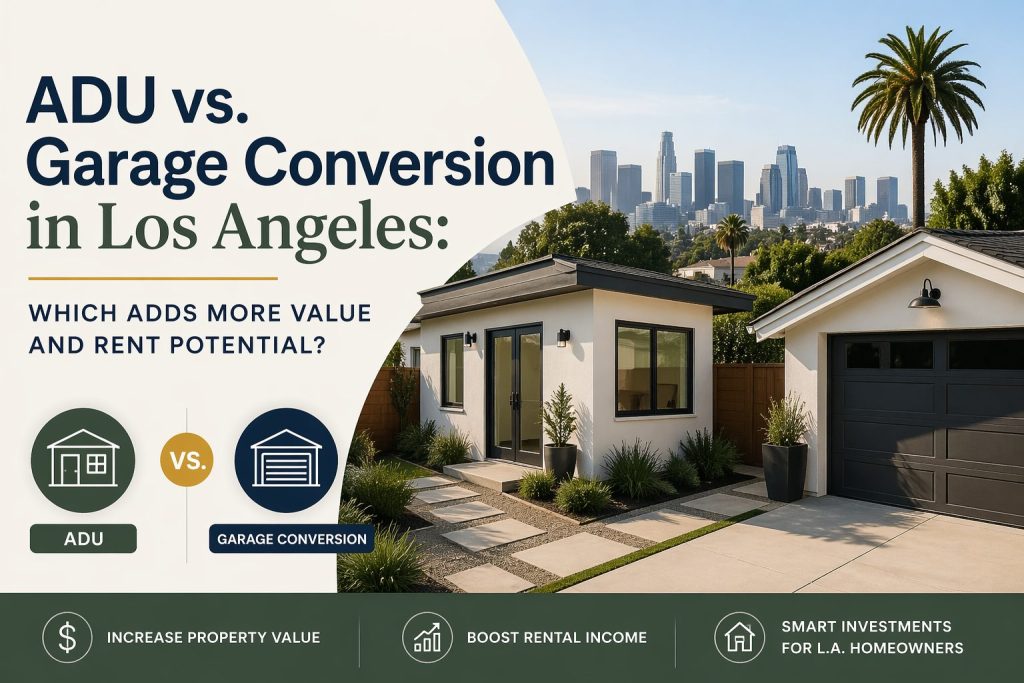
For buyers thinking about value-add potential, also read ADU vs. Garage Conversion in Los Angeles: Which Adds More Value and Rent Potential?.
Step 8: Keep Your Financing Stable While the Deal Is in Progress
Once you are in escrow, the lender is still watching the file. This is not the time to open new credit cards, finance furniture, move large sums around without explanation, or make avoidable financial changes.
The cleanest closings usually come from buyers who stay organized, respond quickly, and avoid unnecessary changes during escrow.
Step 9: Know What Closing Day Actually Means
Closing is the end of the legal process, not the end of the planning process. You will typically move through final loan approval, signing, final walkthrough, and then recording. The practical side matters too, including utilities, property condition, credits, repairs, possession timing, and move planning.
Final Thoughts
Buying a house in Los Angeles is not about predicting the market perfectly. It is about knowing your numbers, understanding your priorities, evaluating properties correctly, and moving decisively when the right opportunity appears.
Most buyers are looking for certainty that does not exist. The better goal is clarity.
If you are early in the process, start with your financial framework. If you are already looking, tighten your evaluation process. If you are ready to make offers, get strategic about how those offers are structured.