Tenant Buyout Disclosure Laws in Los Angeles: What Landlords Must Do Before Offering Cash for Keys
By Paul Adams |
Tenant Buyout Disclosure Laws in Los Angeles: What Landlords Must Do Before Offering Cash for Keys Written by ...
Read Article 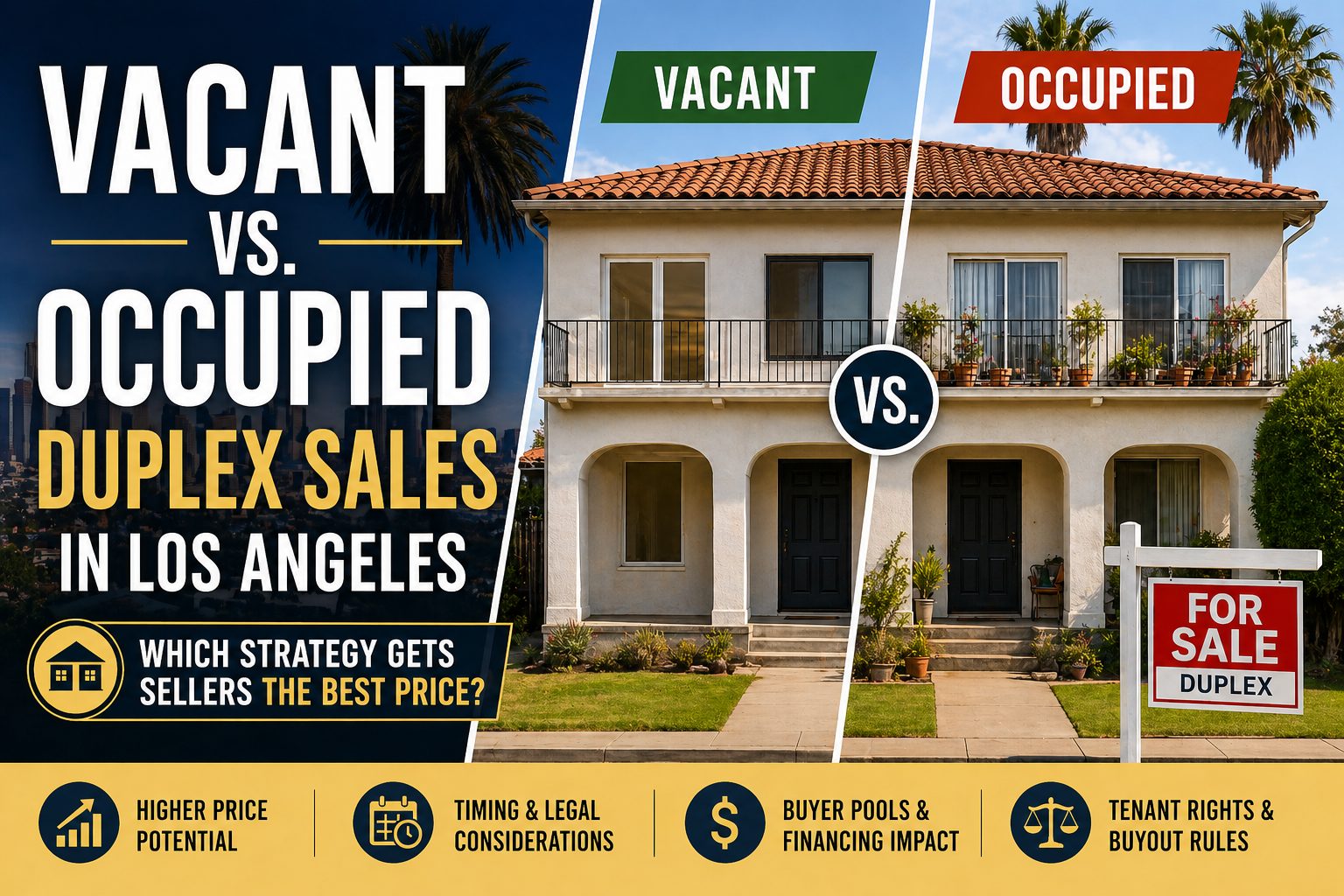
Written by Paul Adams II
Los Angeles Real Estate Advisor
Most duplex owners in Los Angeles think vacancy automatically means a higher sale price.
Sometimes it does.
But not always.
The real question is not simply whether a duplex sells for more vacant or occupied. The real question is whether the extra price you might get from delivering the property vacant is worth the cost, delay, legal complexity, lost rent, and negotiation risk required to get there.
In Los Angeles, a duplex is not just a building. It is a financing vehicle, a housing solution, an investment asset, and in many cases, a rent-controlled property with tenant protections attached to it. This is especially true for owners trying to decide whether to sell, hold, convert, or reposition a small multifamily property. If you are still thinking through the broader value-add strategy, my guide on ADU vs. Garage Conversion in Los Angeles is a helpful companion piece.
A vacant duplex sells a different story than an occupied duplex.
And in real estate, the story often determines the buyer pool.
When you sell a duplex vacant, you are selling control.
When you sell a duplex occupied, you are selling income.
A vacant duplex gives the buyer immediate flexibility. They can move into one unit, rent out the other, renovate, reset rents, choose tenants, or reconfigure their long-term plan without inheriting someone else’s lease situation. That flexibility is valuable, especially in neighborhoods where owner-users, house hackers, and small investors are competing for the same properties.
An occupied duplex gives the buyer existing income, but it also gives them existing conditions. They inherit the tenants, the leases, the current rent levels, the tenant history, and whatever local rent control or tenant protection rules apply. That can be attractive if the rents are strong and the tenancy is clean. It can be a major pricing problem if rents are far below market or the buyer sees future control as limited.
What this actually means in practice is that vacant and occupied duplexes are often evaluated by completely different buyers.
A vacant duplex in Highland Park, West Adams, Leimert Park, Silver Lake, Echo Park, Mid-City, or Mar Vista may attract an owner-user who wants to live in one unit and rent the other. That buyer may be willing to stretch because they are not only buying an investment. They are buying a home, a lifestyle, and a long-term wealth-building plan.
An occupied duplex with below-market rents may attract mostly investors. Those investors are going to look at the rent roll, operating expenses, insurance, property taxes, tenant profile, and realistic upside. They are not going to pay for theoretical market rent unless they believe they can actually achieve it.
That distinction matters because owner-users often price emotionally and strategically. Investors price mathematically.
Vacant duplexes often sell for more because they give buyers something incredibly valuable in Los Angeles: optionality.
Optionality means the buyer has choices. They can decide who lives there. They can decide what rent to charge. They can decide whether to renovate. They can decide whether to occupy one unit, lease both units, create a multigenerational living setup, or reposition the property over time.
That level of control is hard to find in Los Angeles rental property.
Why this matters more than people realize is that buyers do not only pay for what a property is today. They pay for what they believe they can do with it tomorrow. A vacant duplex lets the buyer imagine the best version of the property without being immediately constrained by current tenant terms.
For example, imagine two nearly identical duplexes in West Adams.
One is fully vacant. The other has two long-term tenants paying rents that are significantly below market. Same building type. Similar lot. Similar condition. Similar neighborhood.
The vacant one may attract buyers who want to live in one unit and rent out the other at today’s market rent. That buyer profile overlaps heavily with the same buyer psychology I explain in How to Buy a House in Los Angeles and How Much Do You Need to Buy a House in Los Angeles?, because many duplex buyers are not traditional investors. They are buyers trying to use rental income to make ownership in Los Angeles more realistic.
The occupied one may still be valuable, but buyers will discount for uncertainty: How long will the tenants stay? Can rents be increased? Are the tenants cooperative? Is there a path to vacancy? What restrictions apply?
That uncertainty becomes a price reduction.
The mistake I see sellers make here is assuming buyers will pay for “potential” just because the seller can see it. Buyers pay for potential when they can control it. If they cannot control it, they discount it.
Vacancy is powerful, but it is not always worth chasing.
An occupied duplex can be the better strategy when the tenants are stable, rents are close to market, the leases are clean, and the seller wants a smoother path to market.
This is especially true when the cost of creating vacancy is too high.
In Los Angeles, trying to deliver a property vacant can involve tenant buyout discussions, required disclosures, legal timelines, relocation considerations, and uncertainty around whether the tenant will actually agree to leave.
That matters because a seller cannot casually promise vacancy without understanding what it takes to legally and practically deliver it. Because this topic deserves its own full breakdown, I’ll be publishing a separate guide on Tenant Buyout Disclosure Laws in Los Angeles that explains what landlords need to know before offering cash for keys, including required disclosures, tenant rights, and common mistakes that can create legal exposure.
Here’s a real-world scenario.
A landlord owns a duplex in Mid-City. One tenant is paying close to market rent. The other tenant is slightly below market, but reliable, clean, and cooperative. The seller thinks, “Maybe I should get both units vacant before selling.”
But once you factor in lost rent, possible buyout costs, legal compliance, timeline delays, and the risk that the tenant simply does not agree, the math may not support the strategy.
The smarter approach may be to sell the property occupied, but position it correctly: strong tenant history, clear rent roll, clean documentation, realistic upside, and a buyer pool focused on stability rather than immediate vacancy.
Occupied does not automatically mean weak.
Occupied means the sale has to be framed around income, stability, and future upside instead of immediate control.
This is the part most sellers underestimate.
Vacant vs occupied is not only a property condition. It is a marketing decision.
A vacant duplex generally attracts:
An occupied duplex generally attracts:
This is also why competitive duplexes can behave more like desirable single-family homes than traditional income properties. When multiple owner-users see the same opportunity, the offer strategy starts to matter. I break that down further in How to Win a Bidding War in Los Angeles Without Overpaying.
What this actually means in practice is that vacancy usually widens the buyer pool, while occupancy narrows it.
But a narrower buyer pool is not always a problem if the asset is priced and packaged correctly.
For example, an occupied duplex in a strong rental pocket with clean leases and near-market rents can still be very attractive. A buyer doing a 1031 exchange may care more about placing capital into a stable income-producing property than moving into the next unit. For that buyer, occupancy may be a benefit, not a problem.
But if the property has low rents, unclear leases, deferred maintenance, and difficult access for showings, the occupied status becomes a major drag on value.
The issue is not just whether tenants are present. The issue is whether the tenancy helps or hurts the buyer’s plan.
One of the strongest arguments for vacant delivery is financing.
Many owner-user buyers can use residential financing to purchase a duplex if they intend to occupy one of the units. This matters because owner-user financing can bring more buyers into the market than investor-only financing.
More buyers usually means more competition.
More competition usually means stronger pricing.
Financing is becoming a more important part of the conversation across multiple property types in Los Angeles. I’ll be covering this more directly in Condo Financing Is Tightening in Los Angeles, but the same principle applies here: when financing gets harder, the properties with the cleanest buyer pool and strongest lender story tend to have an advantage.
Investor buyers often face stricter underwriting. They may need larger down payments, stronger reserves, and more convincing income numbers. If the rents are low, the property’s income may not support the price the seller wants.
A vacant duplex in Los Angeles may allow a buyer to say, “I’ll live in one unit and rent the other.” That buyer may compare the property to a single-family home and justify paying more because the second unit helps offset the mortgage.
An occupied duplex with below-market rents forces the buyer to say, “I’m inheriting income that may not support the debt, and I may not be able to change that quickly.”
Those are two very different underwriting conversations.
The smarter way to approach this is to ask: Does vacancy open up better financing and stronger buyers for this specific property?
If yes, vacancy may create measurable value. If no, the premium may not be worth the hassle.
In Los Angeles, tenant protections are not a side issue. They are central to multifamily valuation.
A duplex may be subject to local rent stabilization rules, statewide tenant protections, or other local ordinances depending on the property, location, age, ownership structure, and tenant situation.
This matters because a buyer cannot simply assume they can remove tenants, reset rents, or change occupancy after closing.
Where this becomes a real issue is with long-term tenants paying far below market rent.
Let’s say one unit could rent for $3,200 today, but the current tenant is paying $1,650. On paper, the upside looks massive. But if the buyer cannot legally or practically access that upside in the near future, they will not pay full price for it.
They may still value the long-term upside, but they will discount it based on time, uncertainty, legal cost, and risk.
Potential rent is not the same as collectible rent.
Sellers often want buyers to price the property based on what the rents could be. Buyers want to price the property based on what the rents are, what the law allows, and how long it may take to improve the income.
That gap is where many deals either get negotiated down or fall apart.
Tenant buyouts, often called “cash for keys,” can be a legitimate strategy when handled correctly.
But they are not casual conversations.
In Los Angeles, buyout rules can include required disclosures, written agreements, filing obligations, and rescission periods depending on the jurisdiction and property type.
That means sellers need to be careful.
A poorly handled buyout can create legal exposure, delay the listing, scare buyers, or create uncertainty during escrow.
Here’s the seller mistake: they start negotiating with tenants before they have a clear plan.
The better approach is to first understand:
This is where tenant buyout strategy, rent control rules, and sale timing start to overlap. For landlords considering a cash-for-keys conversation before listing, the next article to read is Tenant Buyout Disclosure Laws in Los Angeles.
Vacancy is valuable only if it can be achieved cleanly.
If the process is messy, uncertain, or legally mishandled, the value can disappear quickly.
Investor buyers look at occupied duplexes differently than owner-users.
They are usually focused on the numbers.
They want to know:
What this actually means in practice is that documentation can directly affect value.
If you are selling occupied and your rent roll is clean, your leases are organized, deposits are documented, tenant payment history is clear, and expenses are easy to verify, buyers feel more confident.
Confidence supports price.
Confusion creates discounts.
If a buyer has to guess, they will usually guess against the seller.
That is why occupied duplexes need more preparation before hitting the market. The listing should not simply say “tenant occupied.” It should tell the income story clearly.
The goal is to make the buyer feel like they understand the asset before they write the offer.
Vacant duplexes are priced more on possibility.
Buyers look at:
A vacant duplex can be marketed almost like a hybrid between a home and an investment property.
That is powerful.
For example, a vacant duplex with two well-laid-out units, separate outdoor areas, good parking, and strong neighborhood appeal may attract buyers who would otherwise be shopping for a single-family home. Once they realize the second unit can produce income, the duplex becomes a more compelling option.
That is when competition can increase.
But the property still has to be presented correctly.
A vacant duplex that looks tired, poorly staged, dark, or difficult to understand may not achieve the full vacant premium. Vacancy creates opportunity, but presentation converts that opportunity into offers.
The property needs to help the buyer imagine the plan.
Even if a buyer is willing to pay more for a vacant duplex, the lender still has to support the value.
This is where appraisals matter.
For a duplex, appraisers may look at comparable sales, income potential, market rents, and overall condition. If the property is vacant, market rent estimates may help support value, but they are still estimates. If the property is occupied, actual rents become part of the conversation.
Why this matters more than people realize is that the highest offer is not always the strongest offer.
A buyer may offer a strong price on a vacant duplex because they believe in the upside. But if the appraisal comes in low, the deal may need to be renegotiated unless the buyer has the cash to bridge the gap.
This does not mean sellers should avoid vacant delivery. It means the pricing strategy needs to be defensible.
The smarter way to approach this is to support the list price with:
Good pricing is not just ambitious.
Good pricing is explainable.
Selling vacant usually makes sense when the property is in a neighborhood with strong owner-user demand and the cost of vacancy is reasonable.
This is especially true when one or both units are already vacant, the tenants are leaving voluntarily, or the seller has a clean and compliant path to delivering vacancy.
Vacancy may also make sense when current rents are so low that they severely limit investor pricing. In that situation, the seller may be leaving significant value on the table by selling occupied.
But the math still needs to be tested.
A seller should compare:
If the vacant premium is meaningfully higher after those costs, vacancy may be the stronger strategy.
If the difference is small, selling occupied may be cleaner and more profitable on a net basis.
Selling occupied usually makes sense when the property has strong tenants, clean documentation, and rents that are close enough to market to support investor demand.
It can also make sense when the seller values speed and certainty more than chasing the highest theoretical price.
For example, if a seller needs to complete a sale within a specific timeframe, waiting months to negotiate vacancy may be a bad move. Even if vacancy could increase the sale price, the delay may create more risk than reward.
Occupied sales also make sense when tenants are cooperative with showings, the property is easy to access, and the buyer pool understands the income profile.
The key is not to hide the tenancy.
The key is to package it professionally.
That means clear rent rolls, lease summaries, expense records, tenant estoppels when appropriate, and a listing narrative that explains why the property still makes sense as an investment.
An occupied duplex needs proof. A vacant duplex needs vision.
For many Los Angeles duplex sellers, the strongest position is not fully vacant or fully occupied.
It is one vacant unit and one occupied unit.
This can create the best of both worlds.
An owner-user can live in the vacant unit and use the occupied unit’s rent to help offset the mortgage. An investor can see existing income while still having control over part of the property. The listing can speak to both buyer types instead of forcing the sale into one narrow category.
This is often especially powerful in neighborhoods where duplexes compete with single-family homes.
A buyer may think they cannot afford the home they want in Los Angeles. Then they see a duplex where they can live in one unit and rent the other. Suddenly, the numbers may feel more manageable.
That buyer may be willing to compete.
This is why partial vacancy can be such a strong positioning tool. It preserves some income while creating enough flexibility to attract owner-users.
For many sellers, that is the sweet spot.
If I were advising a duplex owner, I would not start with “vacant or occupied.”
I would start with the likely buyer.
Who is the most probable highest-paying buyer for this property?
If the answer is an owner-user, vacancy matters more.
If the answer is an investor, income and documentation matter more.
If the property could attract both, the strategy should be built to keep both groups engaged for as long as possible.
Then I would look at the numbers.
Not emotional numbers. Real numbers.
The right answer is the one that produces the best net outcome, not just the highest headline sale price.
Vacant duplexes in Los Angeles can sell for more because they give buyers control, flexibility, and better owner-user appeal.
Occupied duplexes can still sell well when the income is strong, the tenants are stable, and the property is packaged correctly.
The mistake is assuming one strategy is always better.
It is not.
The right strategy depends on the property, the tenants, the rents, the location, the likely buyer pool, the legal framework, and the seller’s timeline.
Vacancy can increase price. Occupancy can preserve income. Strategy determines which one actually makes you more money.
If you own a duplex in Los Angeles, the goal is not just to list it.
The goal is to position it correctly before the market forms an opinion.
If you are comparing this decision with other ownership strategies, you may also want to read ADU vs. Garage Conversion in Los Angeles for value-add planning, How Much Do You Need to Buy a House in Los Angeles? for buyer financing context, and Condo Financing Is Tightening in Los Angeles once that article is published.
If you are trying to decide whether your duplex would sell better vacant or occupied, I can help you compare both scenarios so you understand the likely pricing difference, buyer demand, timing risk, and net outcome before making a move.
Before you negotiate with tenants, promise vacant delivery, or list the property as-is, it is worth building a clear sale strategy around your rent roll, occupancy status, and likely buyer pool. That preparation can make the difference between a clean, competitive sale and a deal that gets discounted during escrow.
Selling a duplex vacant in Los Angeles often leads to a higher sale price because it attracts owner-users and expands financing options. However, selling occupied can provide faster timing, fewer legal complications, and steady rental income during the sale. The best strategy depends on rent levels, tenant situation, and how much value vacancy actually unlocks after costs and delays.
Yes, vacant duplexes often sell for more because buyers have full control over occupancy, rents, and renovations. This flexibility attracts owner-users and house hackers who are typically willing to pay more than investors. However, the price premium must be weighed against lost rent, tenant buyout costs, and the time required to deliver the property vacant.
Yes, you can sell a duplex with tenants in place. The buyer will inherit the existing leases and tenant rights. In Los Angeles, tenant protections and rent control laws may limit a buyer’s ability to change rents or remove tenants, which can affect pricing and the type of buyers interested in the property.
Vacant delivery means the property is sold without tenants occupying the units at closing. This gives the buyer immediate control over occupancy, rent levels, and potential renovations. In Los Angeles, achieving vacant delivery may require tenant buyouts, legal compliance, and careful planning depending on the property and tenancy.
Tenant buyouts, or cash for keys, can help a seller deliver a property vacant and potentially increase the sale price. However, Los Angeles has strict disclosure and legal requirements for buyouts. If handled incorrectly, they can create delays, legal risk, or complications during escrow, reducing the overall benefit.



Paul Adams II | CA DRE# 02232552
Coldwell Banker Residential Brokerage Company | CA DRE# 00616212
The property information herein is derived from various sources that may include, but not be limited to, county records and the Multiple Listing Service, and it may include approximations. Although the information is believed to be accurate, it is not warranted and you should not rely upon it without personal verification. Affiliated real estate agents are independent contractor sales associates, not employees. ©2026 Coldwell Banker. All Rights Reserved. Coldwell Banker and the Coldwell Banker logo are trademarks of Coldwell Banker Real Estate LLC. The Coldwell Banker® System is comprised of company owned offices which are owned by a subsidiary of Anywhere Advisors LLC and franchised offices which are independently owned and operated. The Coldwell Banker System fully supports the principles of the Fair Housing Act and the Equal Opportunity Act.